You are viewing a single comment's thread. View all
0
MI7BZ3EW on scored.co
1 year ago0 points(+0/-0)1 child
So, I once tried studying Sun Tzu. Since I spoke Korean fluently, and I had a good grasp of Chinese writing, I went to the source and compared it with the translation. I knew enough to look up whatever Chinese words I didn't know, and I knew enough to figure out what things meant.
In short, the translations are utter crap.
To wit, Sun Tzu is writing in a strange esoteric style. I recall seeing something like "birds quiet, danger. Birds singing, safe." What this means -- I don't know. Ask 1,000 chinese scholars and you'll get 10,000 answers, most of them contradictory.
Now, the translator turned that in to, "When the birds are quiet, that means that there is some kind of a threat to them, likely enemy movements or camps. If the birds are singing, that means that everything is normal and it's ok to move about." An interesting concept, to be sure, and it sounds like good advice for the battlefield, but was that what Sun Tzu meant? Is that what the readers understand? No, I guarantee you it is not.
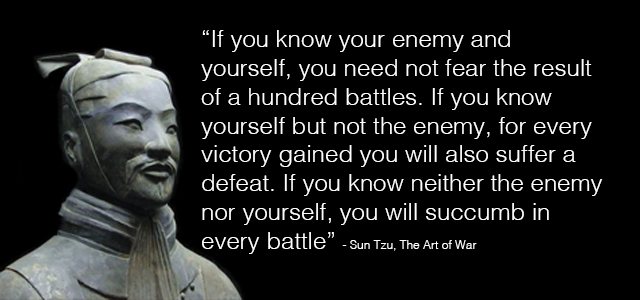
For this quote, I don't have this exact quote in the original Chinese, but I imagine it read something like: "Know enemy self 100 battles no fear; know self not enemy one victory one loss; know enemy self not die battle"
The things is, you might think you can turn that into English, but I guarantee you are wrong. And even if you got the surface level translation right, there is so much more to it than what appears on the surface. For instance, maybe he is talking about the inner battle we face every day. Or maybe he is talking about court politics. Maybe he is referencing "self" as his own troops, so it's talking about understanding the capabilities of your troops and the enemy's troops.
To give you an example, here's a common saying that Koreans use: "Bows to gate post". What does that mean? Good luck figuring that out. And that's a modern one that Koreans still use. Who knows what Sun Tzu was saying 2,000 years ago.
Well, the part about birds is true. Silence - danger, singing - safe. I think he meant when MSM make a lot of noise, it's bullshit, but when MSM are silent, something dangerous is happening. It's like the dogs barking - bullshit, dogs silent - dangerous.



In short, the translations are utter crap.
To wit, Sun Tzu is writing in a strange esoteric style. I recall seeing something like "birds quiet, danger. Birds singing, safe." What this means -- I don't know. Ask 1,000 chinese scholars and you'll get 10,000 answers, most of them contradictory.
Now, the translator turned that in to, "When the birds are quiet, that means that there is some kind of a threat to them, likely enemy movements or camps. If the birds are singing, that means that everything is normal and it's ok to move about." An interesting concept, to be sure, and it sounds like good advice for the battlefield, but was that what Sun Tzu meant? Is that what the readers understand? No, I guarantee you it is not.
For this quote, I don't have this exact quote in the original Chinese, but I imagine it read something like: "Know enemy self 100 battles no fear; know self not enemy one victory one loss; know enemy self not die battle"
The things is, you might think you can turn that into English, but I guarantee you are wrong. And even if you got the surface level translation right, there is so much more to it than what appears on the surface. For instance, maybe he is talking about the inner battle we face every day. Or maybe he is talking about court politics. Maybe he is referencing "self" as his own troops, so it's talking about understanding the capabilities of your troops and the enemy's troops.
To give you an example, here's a common saying that Koreans use: "Bows to gate post". What does that mean? Good luck figuring that out. And that's a modern one that Koreans still use. Who knows what Sun Tzu was saying 2,000 years ago.
If you told them that was the ONLY interpretation, they would laugh at you as being narrow-minded or blind.