1 year ago3 points(+0/-0/+3Score on mirror)1 child
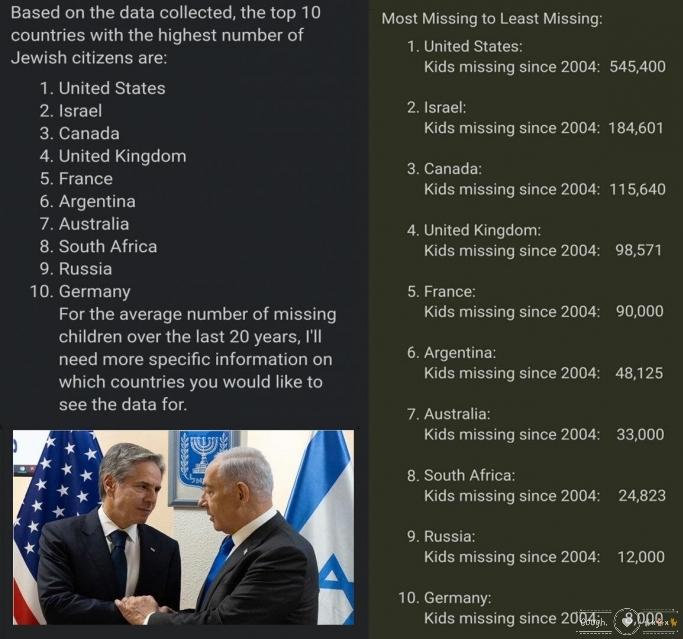
You are (both) wrong. Both statistics are absolute, not relative. The first one is not about the relative amount of jews, but the absolute amount. The second one is about the absolute amount of missing children.
Which means: More jews -> more missing children. You don't have to normalize anything, and in fact it would skew the statistics.
yea but you could just as well say "more Whites, more missing children" or "more greeks, more missing children" or whatever. you do need to look at percentages.
however, you can already suss it out from the OP: israel almost has double the missing children of canada despite only having roughly 25% the total population, which leaves the fact that it's chock full of jews comparatively as a pretty severe correlation.
Hmm yes, you are right about that. There are multiple ways to correlate jews with missing children.
But the one in the post is also quite telling. Also if it were only about population count, it would have to be continually descending and just list the countries with the highest population counts. Also what about India, China, Japan, Korea, Vietnam, Singapore, Middle Eastern countries, etc?



Which means: More jews -> more missing children. You don't have to normalize anything, and in fact it would skew the statistics.
however, you can already suss it out from the OP: israel almost has double the missing children of canada despite only having roughly 25% the total population, which leaves the fact that it's chock full of jews comparatively as a pretty severe correlation.
But the one in the post is also quite telling. Also if it were only about population count, it would have to be continually descending and just list the countries with the highest population counts. Also what about India, China, Japan, Korea, Vietnam, Singapore, Middle Eastern countries, etc?
So it's still useful even in absolute amounts.